
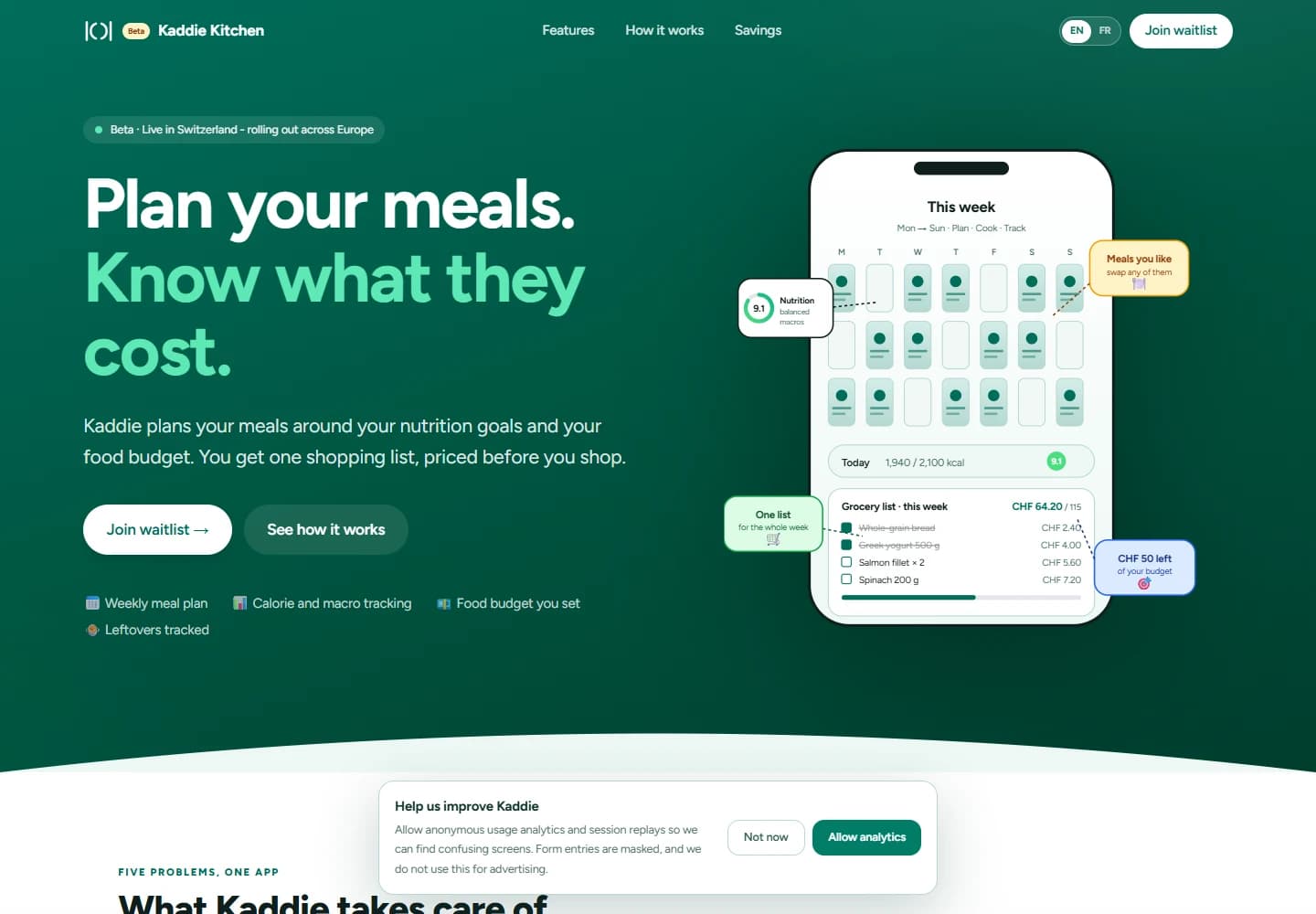
“What should we eat this week?” sounds like one question. In practice, a household has several decisions to make: what fits the budget, what people like, what they need to buy and how much time they have to cook.
Kaddie Kitchen’s founder wanted to address that everyday problem for people in Switzerland and Europe. Nick Creatives worked on the full-stack application over six months, connecting meal planning and grocery shopping for Swiss and French users.
Follow the job beyond the first screen
A meal-planning interface can look complete while leaving the user with a second job: working out what to buy. A shopping list can also be incomplete if the person still needs to reconcile quantities across several recipes.
The useful product question is what the person must do after the feature ends. Where do they open a spreadsheet, make a note or start calculating?
That is often where the next worthwhile connection sits.
Make shared information work across the journey
Kaddie’s public website describes a flow from household preferences and budgeting into a plan, then through shopping and cooking. It also presents nutrition tracking and leftover management.
The product lesson is about relationships. Meal choices influence ingredients. Household size changes quantities. A spare portion can affect what needs cooking later.
In a connected application, those relationships need to be considered together. This is a design and engineering problem, not just a matter of adding more screens.
Local context is part of usefulness
The intended audience matters to the brief. A grocery budget has to make sense in the country where someone shops. Language, currency and local habits can shape whether an experience feels ready for everyday use.
The Kaddie Kitchen website provides English and French navigation and describes local supermarket-based cost estimates. Those are visible elements of its proposition. They are not a basis for claiming a verified reduction in household spending.
For other founders, the question is which assumptions change when the product crosses a border. Identify them before treating expansion as a translation task.
Plan for a working product, then learn from use
The six-month period describes the full-stack development engagement supplied by Nick Creatives. As of 6 October 2026, the public site describes Kaddie as a beta product with waitlist access.
A beta is a stage for learning from real use. Can people complete the core journey? Where do they hesitate? Which information do they need before acting? Answers to those questions are more useful than adding features without feedback.
Apply the same thinking inside a business
The connection to business automation is straightforward. A team may have all the tools it needs and still spend hours moving information between them. The gap between tools becomes somebody’s daily job.
Start by mapping that work. Which decisions can follow fixed rules? Which need interpretation? Which still need a person? Then build a workflow around the whole task.
Read the full Kaddie Kitchen case study for the project story, or bring us a process you want to improve.